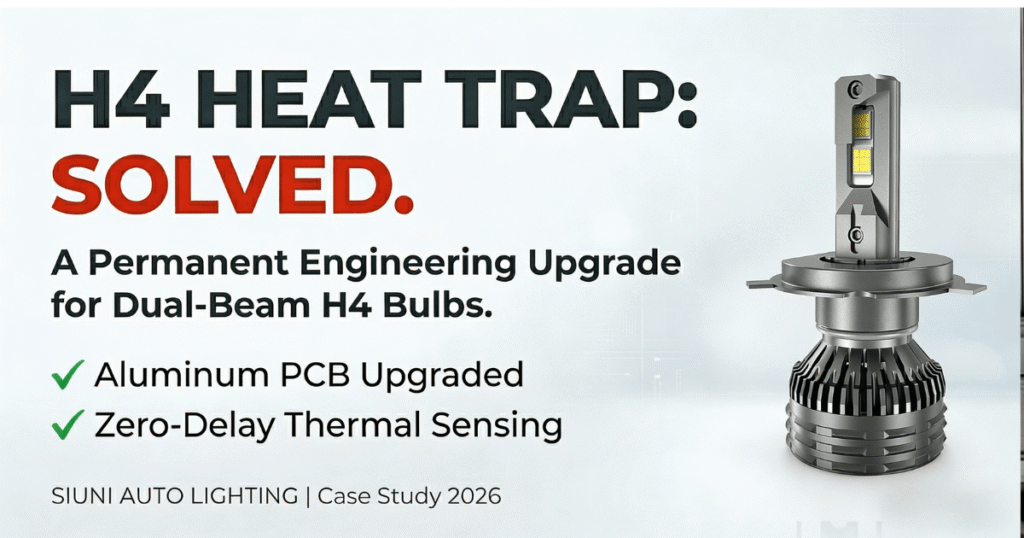
At SIUNI, we take great pride in the quality and reliability of our LED automotive lighting. As a professional manufacturer with 16 years of expertise, we have long been trusted by global LED headlight importers and distributors. For years, our single-beam LED headlights (such as H7, H11, 9005, and 9006) operating at a high power of 70W, alongside our dual-beam models (H4, H13) at 60W, have earned consistent praise for their stable performance and long service life.
However, upon expanding into the demanding Ukrainian market, we received valuable feedback from local partners: while our 70W single-beam headlights maintained their consistent, excellent quality, the 60W H4 dual-beam headlights occasionally experienced isolated bulb burnouts. Knowing that reliable products are the core of long-term cooperation, we immediately tasked our engineering team with investigating this issue. After an in-depth analysis, we identified the root causes and implemented targeted improvements to ensure our H4 bulbs perform flawlessly, even in Ukraine.
Why Do 60W H4 Headlights Experience Occasional Burnouts in Ukraine?
First, it is important to clarify that our H4 dual-beam headlights share the exact same high-quality radiators and core components as our flawless single-beam models. The performance difference is not due to product defects, but rather the unique local operating environment amplifying the physical structural characteristics of the H4.
1. High-Voltage Surges and Aging Electrical Systems:
Unlike the stable voltage supply in many other regions, Ukraine’s vehicle electrical systems—especially in older models like Lada, Opel, and older Hyundai/Kia vehicles—often experience unstable and abnormally high voltage. Idle voltage can range from 14.5V to 15.5V, and sometimes spike over 16V. While single-beam headlights easily cope with this due to a simple constant current mode, H4 bulbs require frequent switching between high and low beams, which generates internal voltage spikes. Furthermore, aging grounding systems in these older vehicles cause reverse electromotive force and high-frequency interference. This complex circuit loop makes the H4 more vulnerable to current impacts in this specific market.
2. Extreme Temperature Differences (Thermal Shock):
Ukraine’s continental climate features extreme temperature drops in the winter. When the headlights are turned on, the LED bulbs experience an instant transition from extreme cold to intense engine heat, creating severe thermal shock.
3. The Unique Thermal Density and “Oven” Effect:
H4 dual-beam headlights have chips arranged on two sides, causing the generated heat to overlap and form a concentrated “heat island”. Unlike our 70W single-beam headlights that have a straightforward thermal path, the 60W H4 integrates two sets of chips into a highly confined space. Furthermore, the H4 low beam requires a physical metal reflector shield to create the standard cut-off line. This shield physically blocks natural heat convection and reflects heat back toward the LED chips, acting like a localized “micro-oven.” This extreme thermal density, combined with Ukraine’s harsh environment, pushes the heat management to its absolute limit.
From Good to Great: Our Engineering Team’s Targeted Upgrades
To ensure the H4 performs as reliably as our single-beam headlights, our engineering team implemented two simple but highly effective hardware upgrades.
Improvement 1: Zero-Delay Thermal Sensing via Thermal Grease
The thermistor is responsible for monitoring temperature and triggering the driver to reduce power if the bulb overheats. Previously, microscopic air gaps meant the thermistor was not in perfect contact with the aluminum substrate, leading to slightly delayed temperature detection. Our solution: We now apply a precise layer of premium thermal grease around the thermistor and its contact surface. Since air is a poor heat conductor, eliminating this gap ensures the thermistor can instantly and accurately detect temperature spikes. As soon as the heat rises, the driver immediately reduces power to protect the chips from burning out.
Improvement 2: Upgrading to an Aluminum PCB (Aluminum Substrate)
The original driver board was made of fiberglass, which has standard thermal conductivity. In Ukraine’s high-voltage environment, the driver’s IC, MOS tubes, and capacitors generate significant heat that must be dissipated rapidly. Our solution: We completely replaced the fiberglass board with an Aluminum PCB. Aluminum offers superior thermal conductivity, quickly dissipating heat from the driver components and ensuring stable current supply without dangerous ripples or spikes.
Commitment to Quality: SIUNI’s Promise to Our Global Partners
At SIUNI, we believe quality is the foundation of trust. The occasional burnout of H4 headlights was a response to a uniquely harsh environment, and our targeted engineering upgrades have permanently addressed these root causes.
We are constantly optimizing our products based on real-world market feedback. By understanding the micro-physics of thermal management, we ensure our 60W H4 dual-beam headlights deliver the exact same flawless performance as our 70W single-beam products.
If you are an automotive lighting importer seeking a trustworthy factory that obsesses over product stability, please visit siuniauto.com or contact our technical support team. We are always here to help you win your market.